
02 / Overview
Overview
Content Pipeline AI is an independent academic project exploring how AI-assisted campaign planning can remain understandable, reviewable, and recoverable.
The project addresses a fragmented workflow: campaign briefs, generated drafts, approvals, and publishing dates often live in separate tools. I designed a connected workspace where users can define a campaign, follow its processing stages, review proposed content, and organize approved materials.
I established the product requirements, evaluated technical options, and directed the responsive interface design. I developed a Next.js frontend, a FastAPI backend, PostgreSQL persistence on Neon, and a separate Python worker.
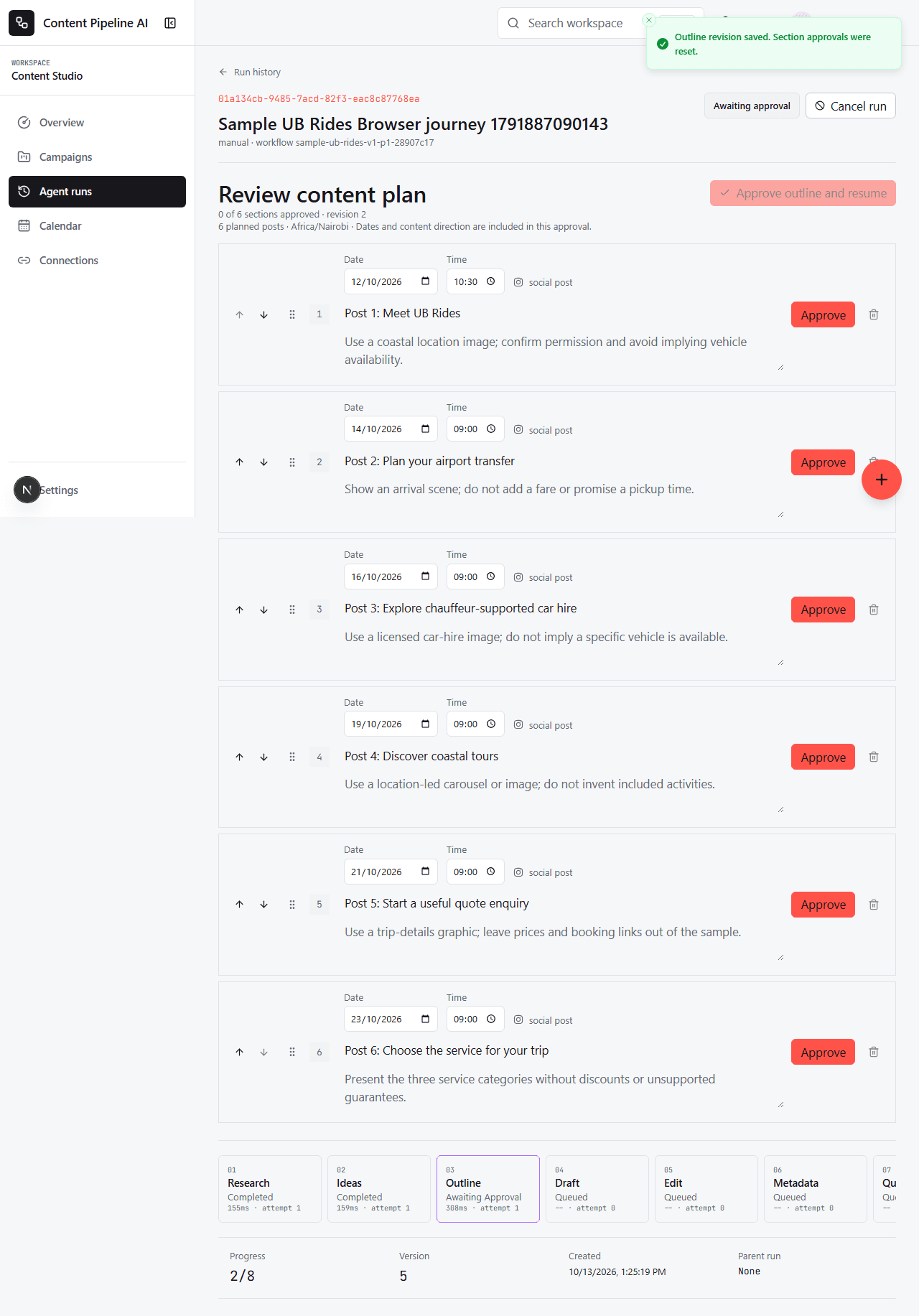
The workflow pauses after Outline generation so users can edit and approve the exact revision before processing continues. Content revisions, quality results, and schedule items retain their relationships, helping prevent outdated or unapproved material from being exported.
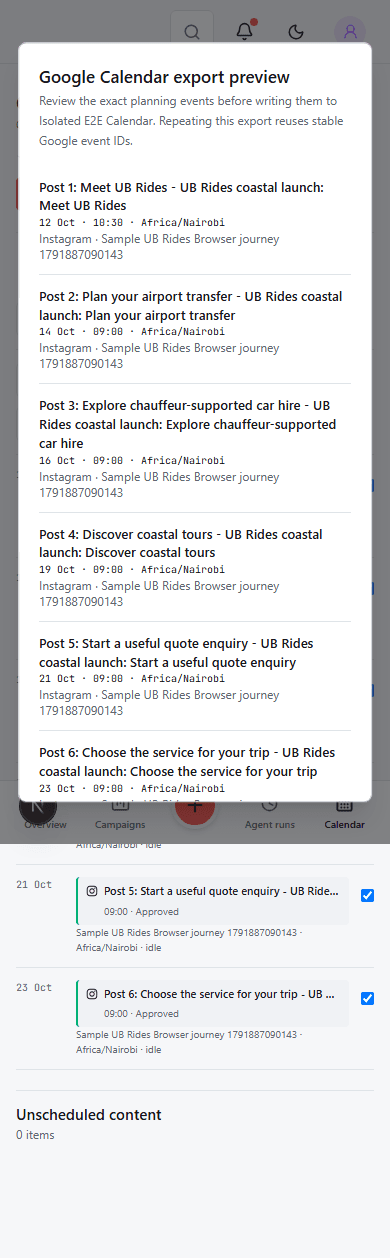
Google authentication and Calendar export are implemented. Direct social publishing is intentionally outside the current release scope.
Testing includes isolated browser journey, ownership checks, recovery scenarios, and bounded live AI requests. Live validation has successfully produced Research, Ideas, and a corrected six-section outline. Complete live draft-generation acceptance and production deployment remain outstanding.
UB Rides provides the example campaign scenario; it is not presented as a commissioned client engagement.
03 / Contribution
My Role and Scope
My role
Product definition, UI/UX direction, full-stack development, API integration, testing and debugging.
Audience
Content Management, Marketing agency
What I contributed
I defined the campaigning workflow and directed the design and development of a responsive workspace for creating briefs, monitoring generation, reviewing outlines, editing content and managing schedules. I integrated authentication, persistent storage, background processing and Google Calendar export, then tested ownership boundaries, revision handling and recovery from failure.
Deliverables
Campaign workflow, responsive application, content review, quality checks, Calendar export
04 / Process
Decisions and Evidence
01 / Context
Context
Content Pipeline AI began as an academic project exploring how one application could integrate campaign briefs, AI-assisted planning, human review, and scheduling. UB Rides provided the example campaign scenario, rather than a commissioned client brief.
02 / Challenge
Challenge
The challenge was making generated output useful and controllable, not merely producing text. The workflow needed to handle incomplete responses, provider failures, outdated revisions and approval requirements without losing progress.
03 / Research
Research
I evaluated database, authentication and AI-provider options through documentation review and local testing. These investigations informed the use of PostgreSQL on Neon, Better Auth, a separate Python worker and bounded generation requests.
04 / Insights
Insights
A successful API response did not necessarily produce an acceptable campaign. One live Outline repeated its first post to fill the sixth slot. Reviewing that output exposed a mapping defect that basic schema validation had not caught.
05 / Strategy
Strategy
I prioritized a complete, testable English Instagram workflow before expanding the improved generation process to other formats. Human approval, exact posting counts and explicit limitations took precedence over claiming broad platform readiness.
06 / Design
Design
I directed a compact, responsive workspace with mobile button navigation, visible pipeline stages, and separate review areas. Audience-facing copy remained disctinct from production guidance, while approval and revision states made content readiness explicit.
07 / Development
Development
Using AI-assisted development with Codex, I implemented persisted stage checkpoints, revision-specific approvals and duplicate-safe Calendar export. Regression tests covered ownership isolation, recovery, posting-slot mapping and invalid provider responses.
08 / Reflection
Reflection
The project reinforced the distinction between implemented functionality, tested behavior and demonstrated user value. Offline samples supported development, but remained labelled separately from live AI output. Production readiness and measurable efficiency gains require further validation.
Evidence
Repository acceptance records document working review and scheduling flows, 222 passing backend tests in the latest recorded verification, successful live AI planning, and Calendar export checks. These substantiate implemented functionality, not reduced workload or time savings. No usability study, customer adoption data or measured efficiency improvement has been recorded.
05 / Visual work
Gallery


01 / 05
06 / Intended outcome
Outcome
Help users manage campaign planning, content review, and scheduling in one workspace, with clearer approval checkpoints and less reliance on disconnected tools.